입찰부터 대금 회수까지. 하나의 시스템에서 프로젝트 비즈니스를 운영하세요.
제안, 계약, 인력 배정, 딜리버리, 시간, 청구 및 마진을 하나의 데이터 모델로 연결합니다. 입찰에서 약속한 내용이 그대로 인력 배정, 딜리버리 및 청구로 이어지며, 아직 조치를 취할 수 있을 때 매출 예측을 조정할 수 있습니다.
Planisware Luma
Image

입찰부터 대금 회수까지. 하나의 시스템에서 프로젝트 비즈니스를 운영하세요.
제안, 계약, 인력 배정, 딜리버리, 시간, 청구 및 마진을 하나의 데이터 모델로 연결합니다. 입찰에서 약속한 내용이 그대로 인력 배정, 딜리버리 및 청구로 이어지며, 아직 조치를 취할 수 있을 때 매출 예측을 조정할 수 있습니다.
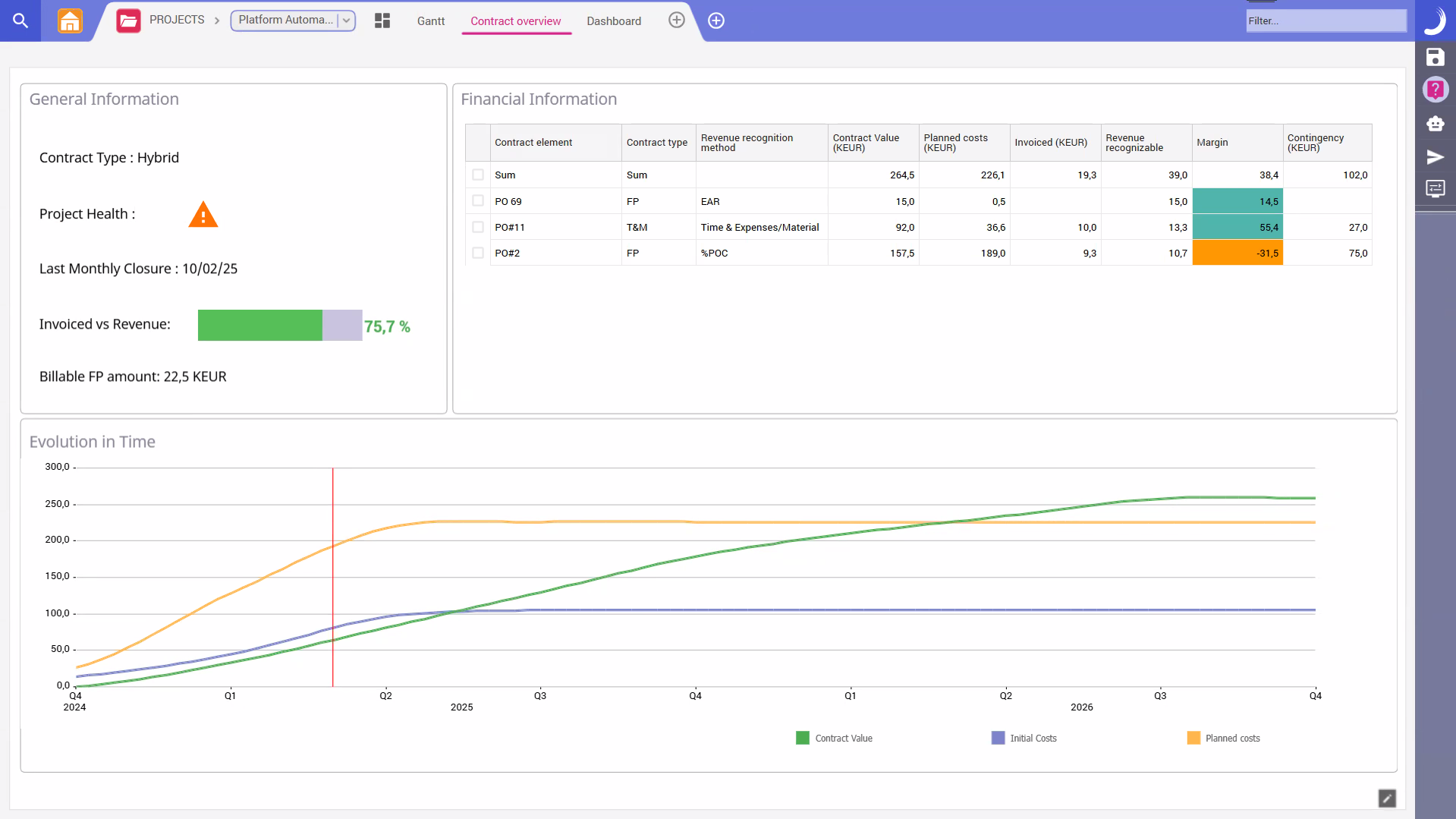
제안부터 인보이스까지 수치를 직접 관리하세요. 과거 및 파라메트릭 데이터를 활용해 견적을 산정하고, 가격을 확정하기 전에 제안 손익을 확인할 수 있습니다. 하나의 계약에서 정액제, T&M 및 마일스톤 기반 업무를 운영하고, 변경 주문을 계약에 바로 반영하며, 청구와 마감 전 과정에서 목표 대비 마진 및 매출 예측을 추적합니다.
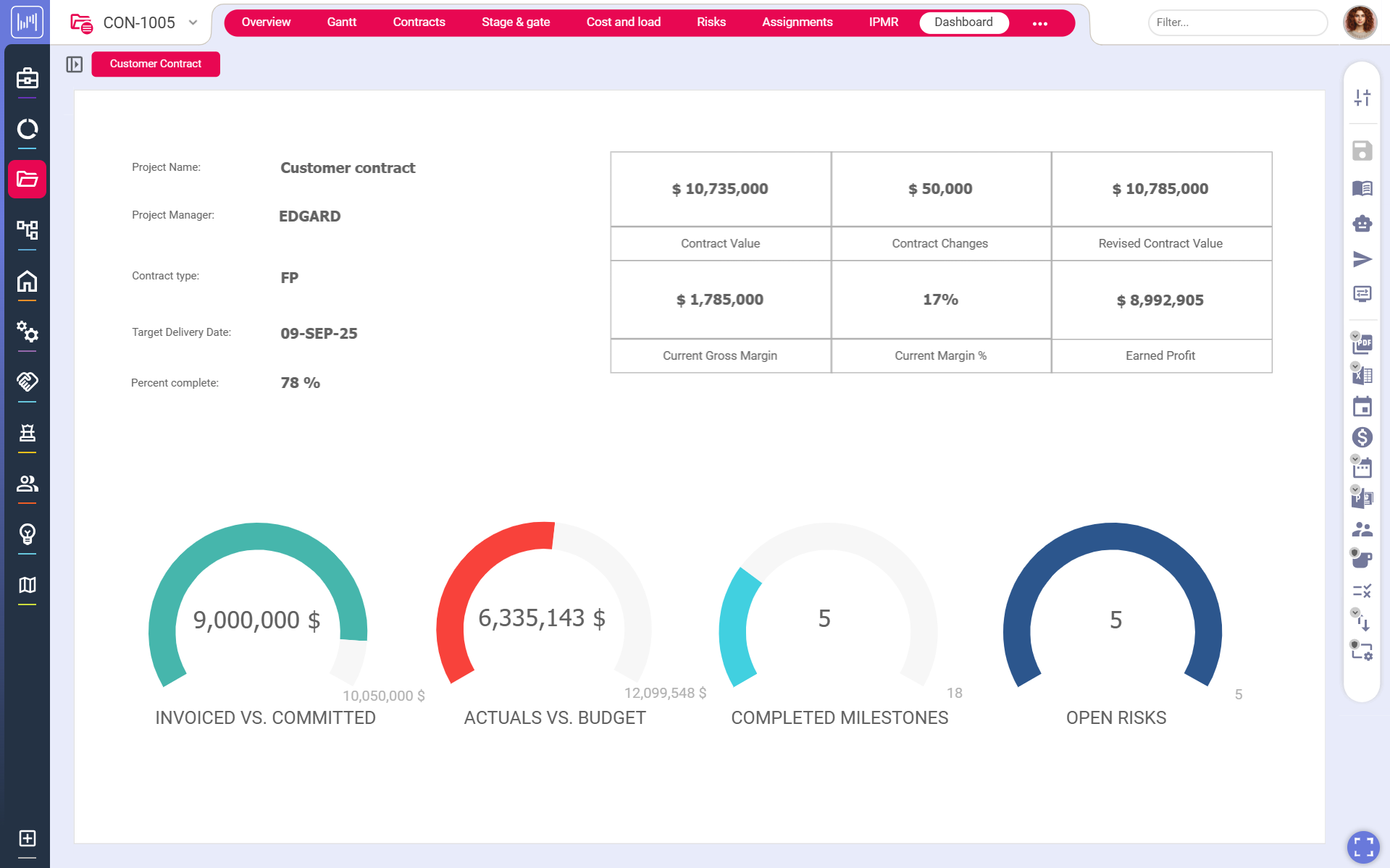
보유한 인력으로 수주한 업무를 수행하세요. 스킬, 자격 및 가용성을 확정 수요와 예측 수요에 매칭하고, 전체 포트폴리오의 리소스 경합을 파악하며, 목표 대비 활용률을 추적합니다. 데스크톱이나 모바일에서 업무 구조에 따라 시간을 기록할 수 있으며, 현장에서는 오프라인 입력도 지원됩니다.
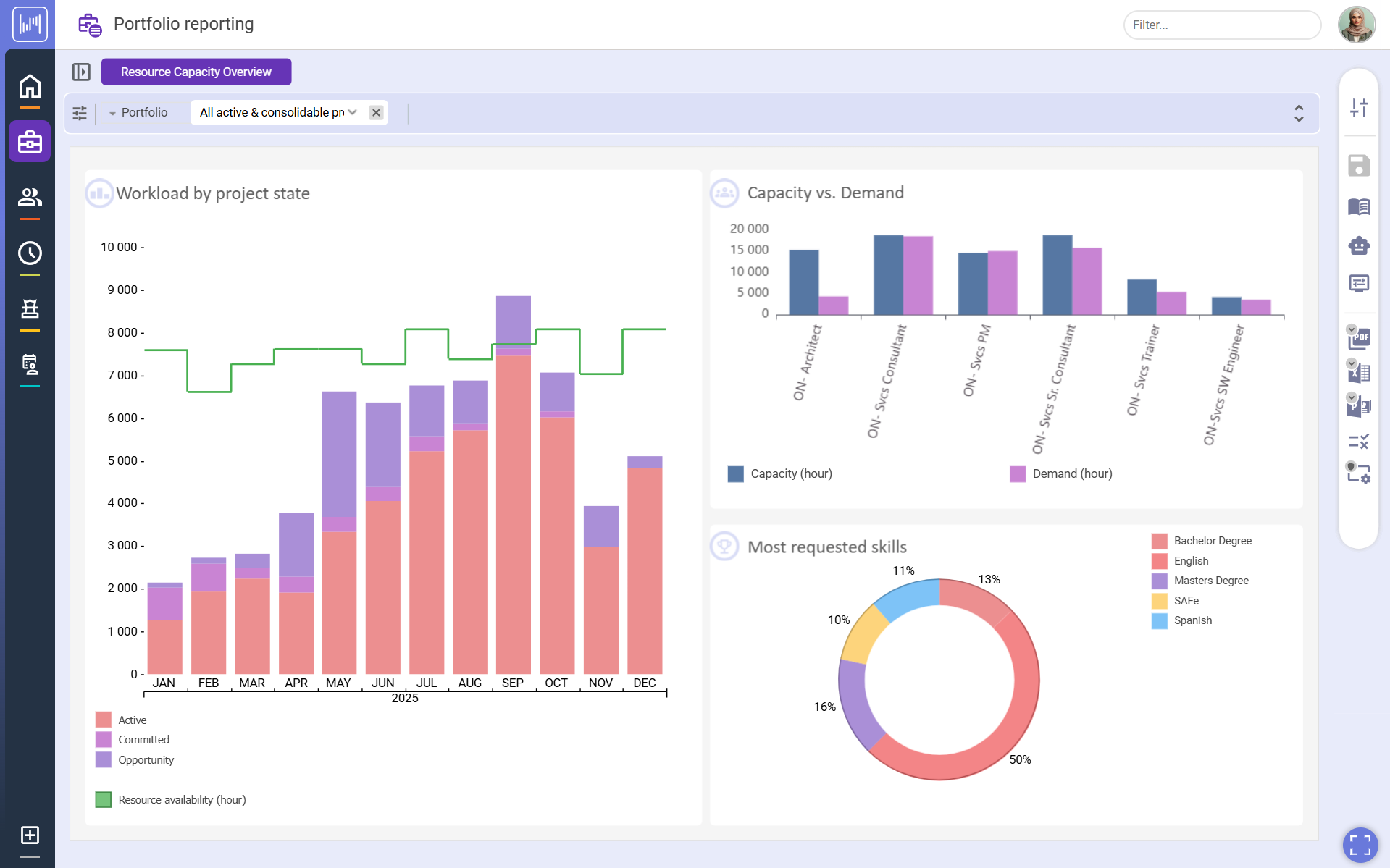
단순한 작업 목록을 넘어서는 계약을 위해 설계되었습니다. 업무를 담당자와 비용이 지정된 작업 패키지로 세분화하고, 주공정과 기준선을 활용해 일정을 계획하며, 완료 시점 추정치(EAC)와 획득가치를 관리합니다. 워터폴, 애자일 및 스테이지 게이트 방식의 딜리버리를 병행할 수 있습니다.
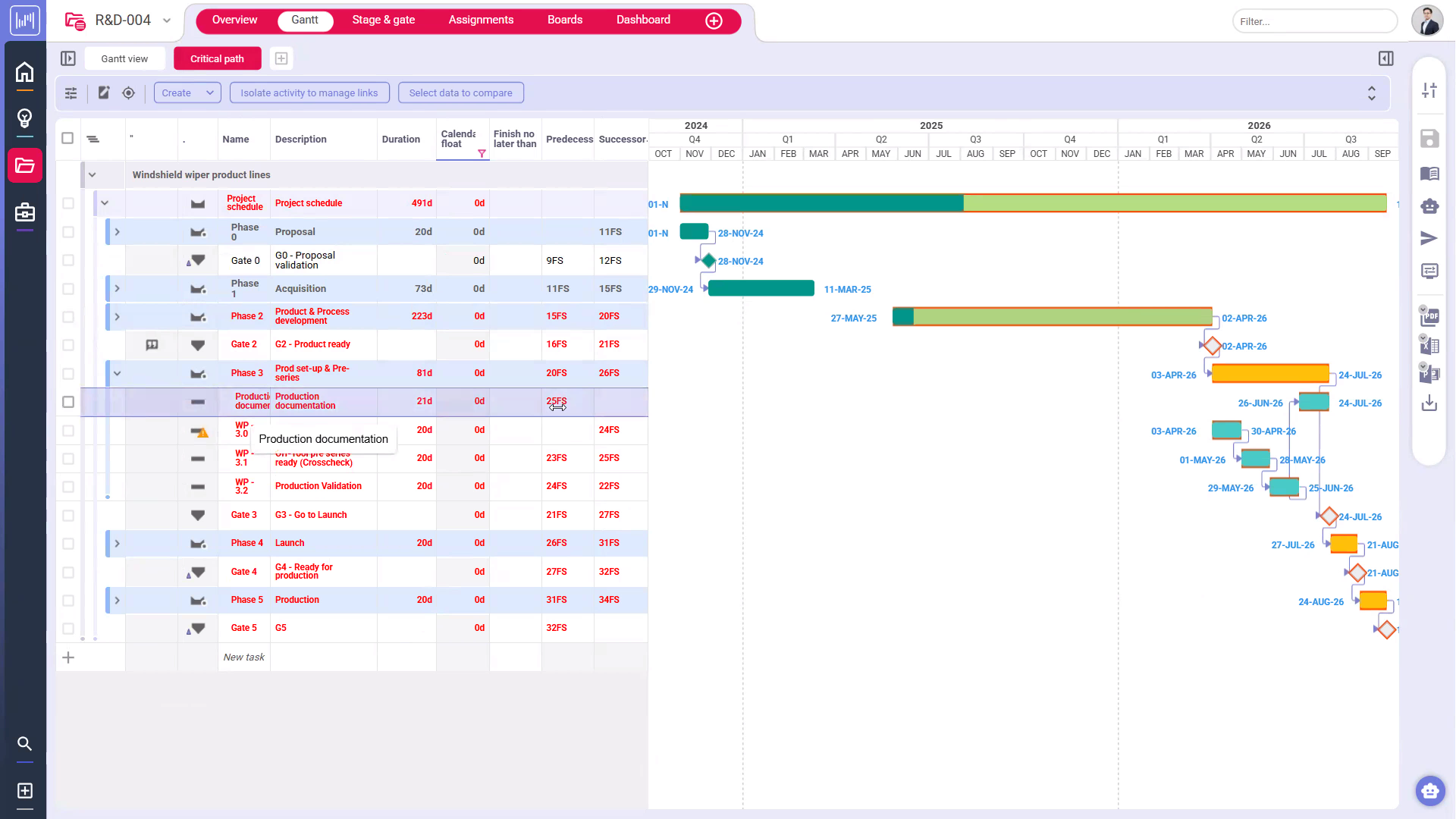
프로젝트부터 포트폴리오까지 하나의 일관된 수치를 제공합니다. 바로 사용할 수 있는 표준 대시보드를 통해 프로젝트별 손익과 법인, 계약 유형 및 고객별 통합 손익을 확인할 수 있습니다. 인력 배정, 커미트먼트, 비용, 매출 및 마진이 한곳에서 일치합니다.
Bid with confidence, staff what you sold, and resolve contention before delivery dates move.
A defensible close, a revenue forecast you can stand behind, and one view of what your project business is worth.
One process from proposal to closeout, and one set of numbers everyone trusts.
Any CRM, any ERP, one vendor across your project estate.

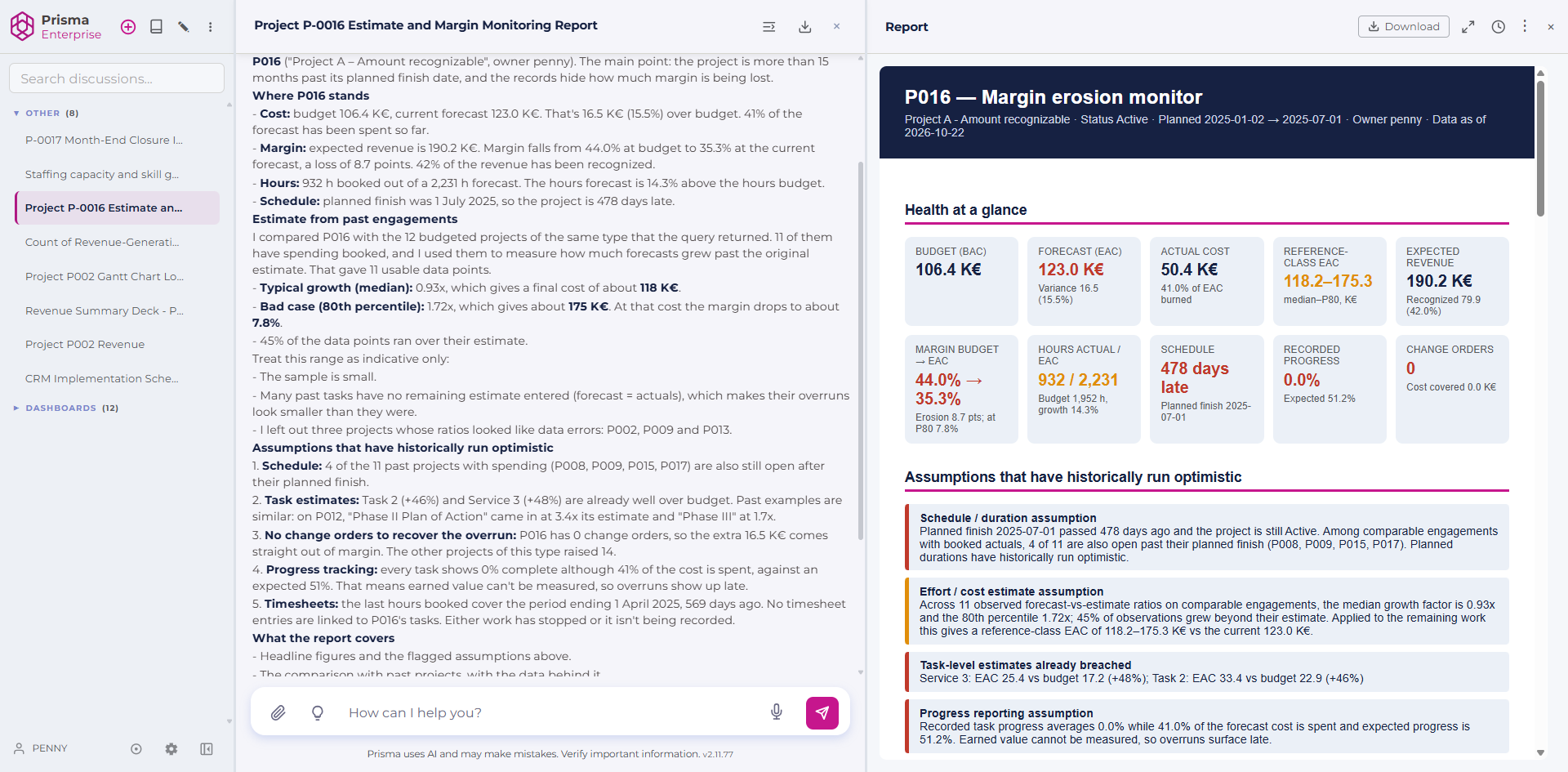
Agents estimate from comparable past engagements and flag assumptions that have historically run optimistic. They monitor progress, cost, change orders and timesheets for margin erosion, and alert you before the period closes.
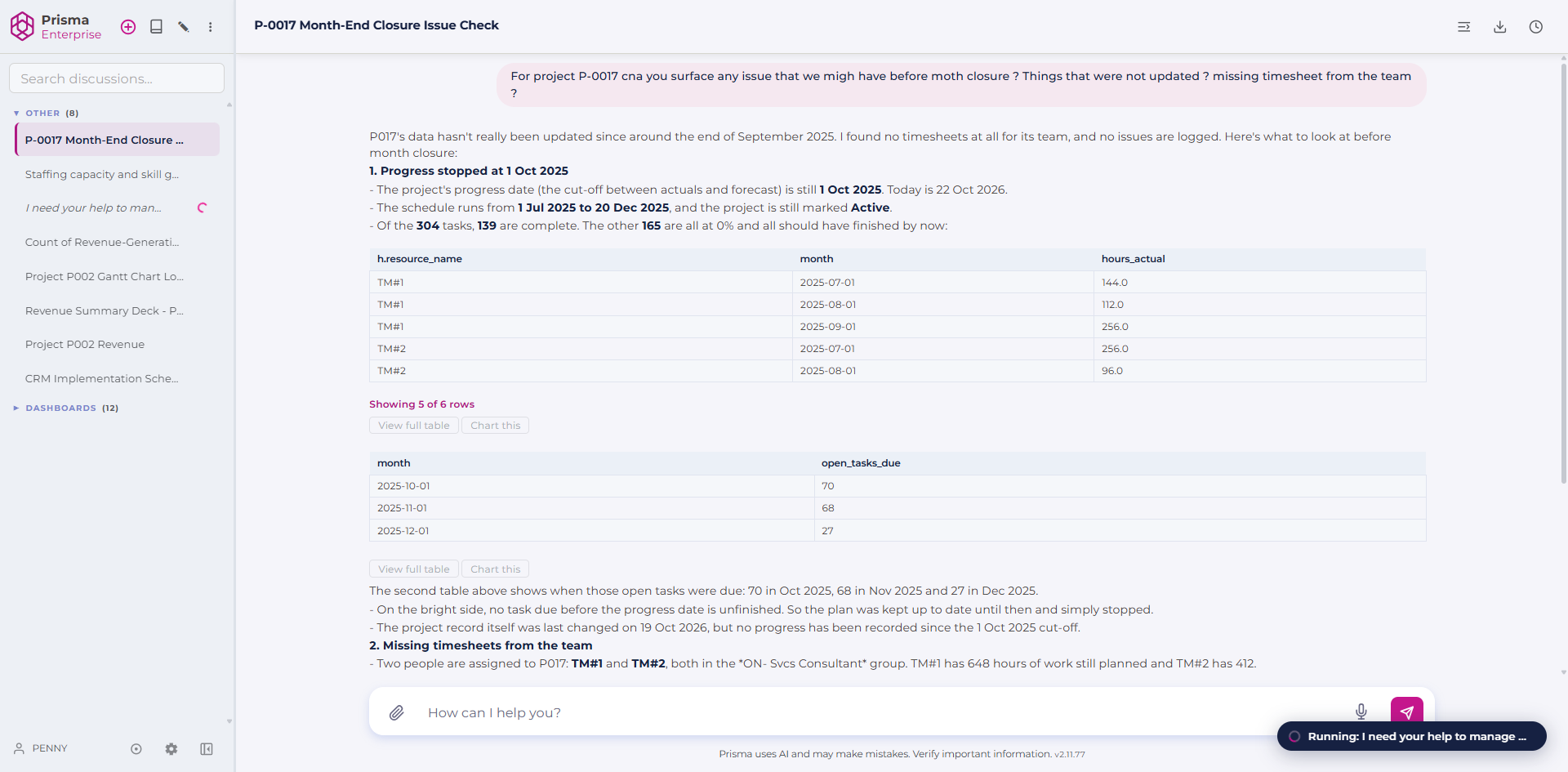
Agents propose feasible staffing against skills, availability and cost, and show the contention each option would create. They surface bench risk and the hire-or-subcontract decision that follows.
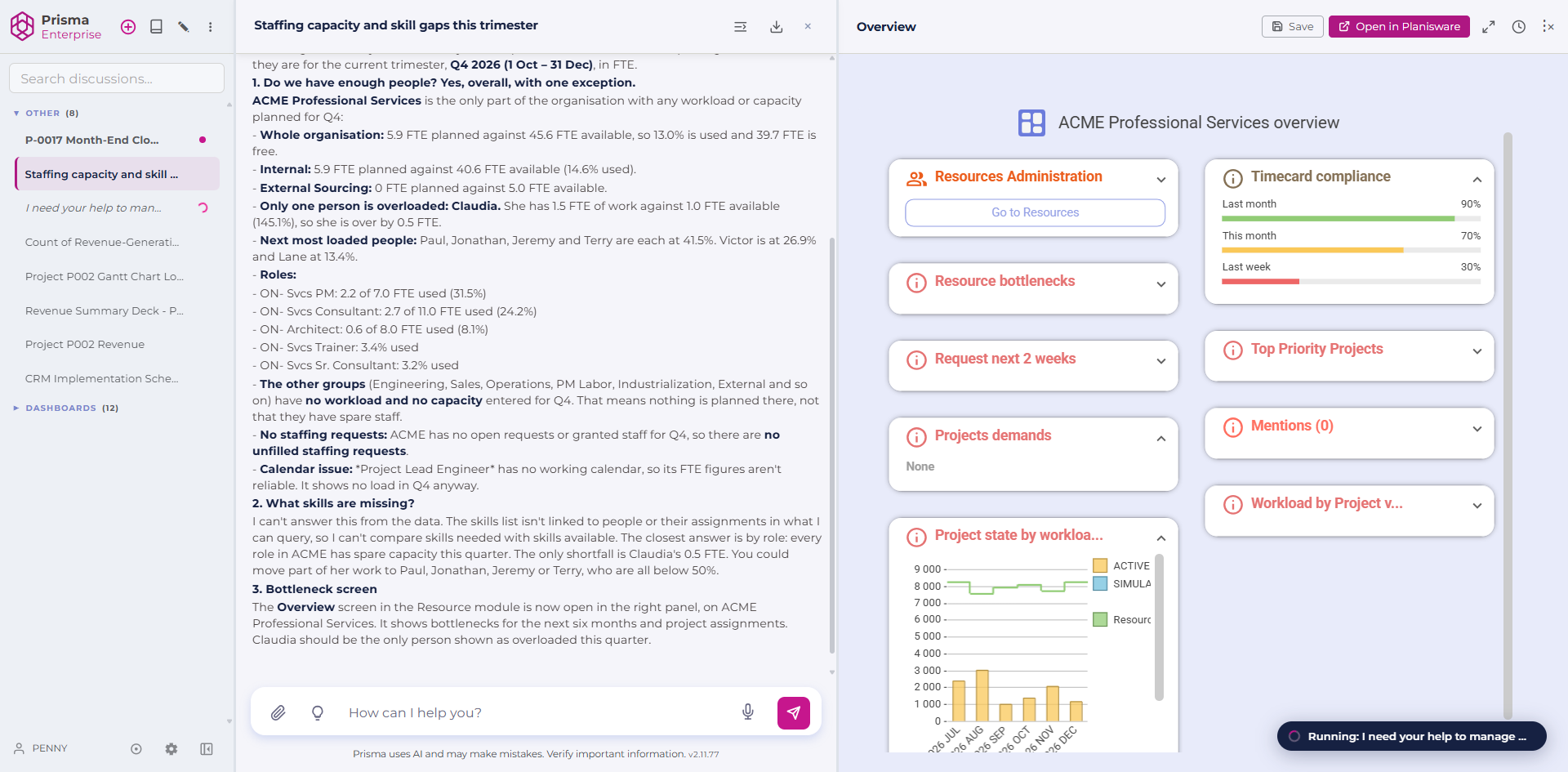
Agents build revenue, cash and backlog forecasts from contract structure, progress and pipeline. They surface missing timesheets, inconsistent accounting periods and overdue revenue lines before month-end.

Planisware sits between your CRM and your ERP: opportunities come in, contracts and budgets go out, and each system keeps doing its job while the commitment finally has an owner.
Tractebel halved approval time by connecting Planisware to its ERP.
PSA guides, demos and customer stories in one place.
See the full picture of the bid-to-cash chain in a single overview.
See your own contracts, rates and resources in Planisware.
Professional services automation (PSA) is software that connects the commercial chain behind customer projects: proposal and bid, contract, staffing, delivery, time capture, billing and margin. Any organization that earns revenue by delivering projects to a paying customer can use it, including consultancies, engineering firms, research organizations and industrial suppliers.
The deciding test is contract direction: who is the project for, and does it generate revenue? If the answer is an external customer and yes, the organization runs a customer project business, even if it never described itself as a services firm. PSA is well established: 68.9% of surveyed professional services firms already run a PSA platform (SPI Research, 2026 Professional Services Maturity Benchmark).
A PSA solution typically covers:
The article Professional Services Automation: The Unique Outcomes That Differ From PPM and 7 Proven Ways to Manage Service Engagements Efficiently go deeper on each area.
The three categories answer different questions. An ERP project module records what was spent, a PPM tool prioritizes internal work, and PSA manages the commitment made to a customer, from the bid to the invoice.
| ERP project module | PPM tool | PSA | |
|---|---|---|---|
| Purpose | Financial record of projects | Internal portfolio planning | Operational and commercial management of customer projects |
| Main users | Finance and controlling | PMO and portfolio managers | Bid teams, delivery leaders, resource and project managers |
| Commercial model | Recorded after the fact | Not part of the model | Contracts, rates and billing as first-class objects |
| Resources | Typically basic | Capacity across internal projects | Skills and availability against signed and forecast demand |
| Margin view | After costs post | Cost against budget | Continuous, against baseline, with estimate at completion |
PSA does not replace the ERP. It sits above the ledger, pushing approved budgets and pulling actuals and commitments, which is covered in Seamless integration with your critical enterprise applications. For the contrast with PPM, see the PSA and PPM outcomes article, and for the quote-to-cash flow, the client billing guide.
No. Recognition entries stay in the finance system. PSA maintains the operational data those entries depend on and shows the revenue forecast against target while there is still time to act.
The reason is where the data lives. Standards such as ASC 606 and IFRS 15 work on performance obligations and progress, which sit with the delivery team, not in the ledger. A simple test: how does the ERP know percent-complete on a fixed-price milestone? In many organizations, someone rebuilds it in a spreadsheet every month.
| Stays in the finance system | Managed in the PSA solution |
|---|---|
| General ledger and recognition entries | Contract structure, performance obligations and change orders |
| Accounts payable and receivable | Progress and delivery status that drive percent-complete |
| Invoice posting and payment | Revenue forecast against target, and a managed period close |
The connection between the two is what removes rework. At Tractebel, integrating Planisware with the ERP halved approval time. The client billing guide shows how time, rates and approvals flow into invoicing.
Because time is the foundation of every PSA number. Utilization, billing accuracy, margin and progress cannot be calculated without complete, well-structured time data.
Planisware supports task-level time entry on desktop and mobile with configurable approvals; the interactive Time Card demo shows it, including warnings on missing or out-of-policy entries. For the link to billing, see the client billing guide, and for the governance angle, 7 Proven Ways to Manage Service Engagements Efficiently.
PSA gives leaders one trusted view of margin, capacity and cash, so they can steer engagements while the outcome can still change. Success is measured by a small set of delivery and financial indicators, tracked against a baseline.
| Metric | What it shows | Benchmark (SPI Research) |
|---|---|---|
| Billable utilization | Share of capacity actually billed | 66.4% in 2025, versus 75% considered optimal |
| Project overrun | Gap between plan and actual | 10.7% in 2025, above the 10% threshold |
| On-time delivery | Commitments met | 73.8% in 2025 |
| Project margin | Profit kept on engagements | 37.7%, with firm-level EBITDA of 9.9% |
Beyond benchmarks, track bid accuracy, how many change orders reach the contract, close duration, DSO and forecast against actual. Customers see the effect: Tractebel cut project creation time by 40%, and ABB reports reduced margin erosion and shorter execution times. See the client billing guide, 7 Proven Ways to Manage Service Engagements Efficiently and Episode 2: Proposals & Bidding for the real-time financial dashboards.
Start with a focused first phase and build outward. PSA touches sales, delivery and finance, so sequencing and change management decide the outcome.
The scale is achievable: ABB runs 2,500+ users across 50 local units, and Tractebel has run its project managers on Planisware since 2021. Read How 2,500 Users Achieved Project Success at ABB Using Planisware, watch Episode 1: Intake Management, or request a demo.